
It’s been an interesting time since my last post. If you haven’t read my earlier blogs, here’s the TL;DR: about 3 months ago I decided to finally bite the bullet and try AI coding / Vibe coding / Agentic engineering or whatever it’s called now.
Coincidentally, a few weeks back one of my favorite movies, Top Gun Maverick, was rereleased in IMAX and afterwards, I found myself thinking about the parallels between the movie and my AI coding journey.
It would be accurate to say I completely threw myself into this idea of Agentic Engineering. I tried out a variety of harnesses, UIs, models etc. I initially started with Claude Code. Then I pivoted to OpenCode. The main benefit with that was the support for a multitude of providers. The point isn’t which setup won, it’s that I went deep enough to form a real view.
It’s Where I Belong
So here’s my conclusion over the last 6 months. I reject this ludicrous proposition that we all need to be Agent managers running a team of 5-10 agents in parallel and somehow 100x our output without sacrificing quality. Screw that. I am a developer whether I am using a text editor or an IDE or a coding agent, for as long as I can be, and when the day of reckoning finally arrives and they replace us, then I will go do something else. I still use Copilot CLI at work for boring or uninteresting tasks, and I use Claude Code at home for my personal projects.
In Top Gun Maverick, there’s a reason that they don’t use the latest generation F35 fighters for their mission, instead opting for the older F18 because that’s what the mission parameters demand. The F-35 was sidelined because the target was in a deep canyon protected by GPS jamming. The plane’s greatest strength—its reliance on interconnected data and autonomous sensor fusion—became a liability in an environment where the “network” was compromised.
The F-35 is an information-dominance machine. Its superpower isn’t necessarily dogfighting; it’s “sensor fusion”—taking data from everywhere and painting a complete picture of the battlespace so you can strike from beyond visual range.
Agentic coding tools do exactly this. Give them a pristine, modern codebase with clear documentation, and they are unmatched. They can read thousands of files, understand the entire architecture, and refactor tons of modules at light speed.
The F-18 on the other hand fit perfectly for the mission parameters of low altitude flight, high maneuverability and dogfighting capabilities. The F-18 is the editor and my own judgement — slower, less glamorous, but it flies where the network can’t reach.
That’s the exact same philosophy I wish to apply to my work as well. We should choose the tool based on our judgement of the task at hand. No-one gets to tell me when to use an IDE and when to use an AI agent.
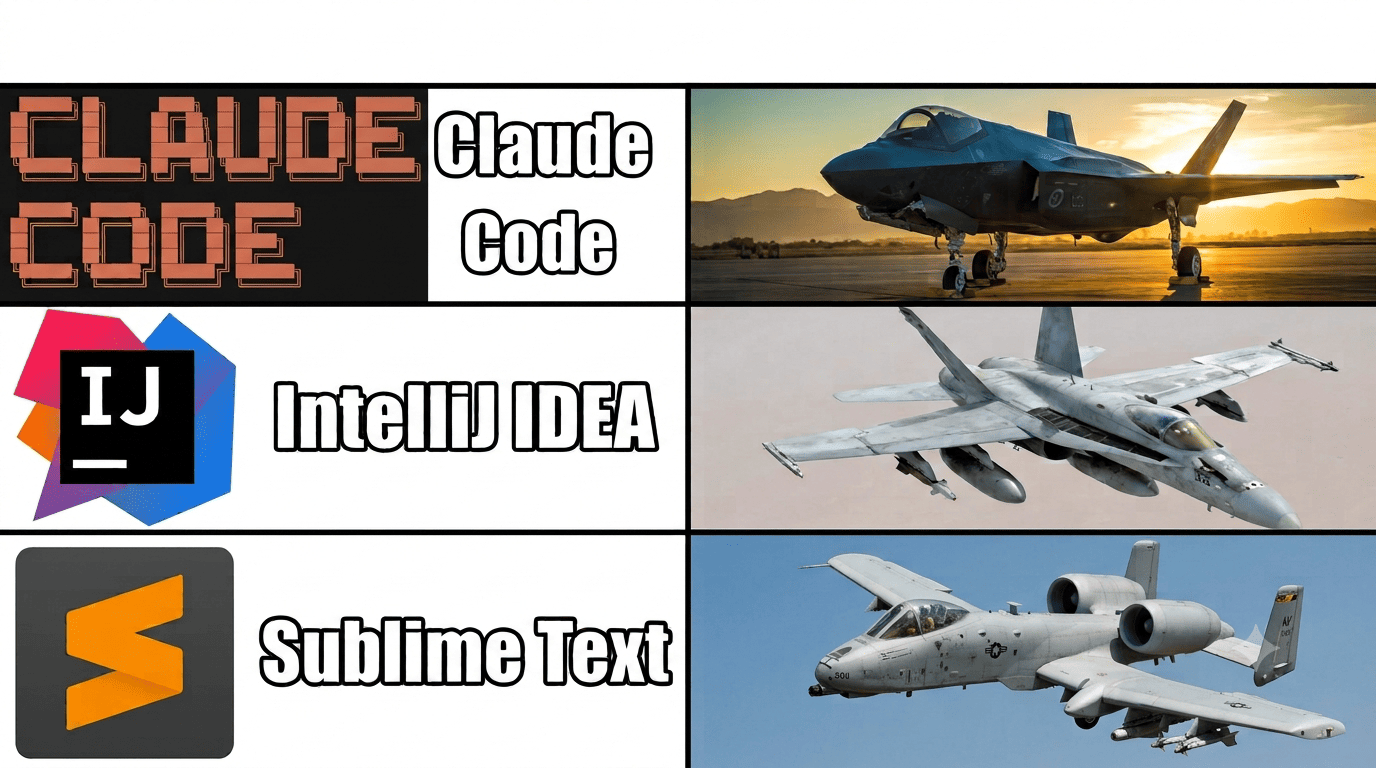
I haven’t written React code in many years and don’t really remember any of it. So when I had to jump into a React codebase and build a new feature, I heavily leaned on OpenCode to do the heavy lifting while I used my past understanding of React patterns, best practices to guide it. The outcome was honestly surprisingly good. Now, the task at hand was not complex at all and neither was the codebase but that’s part and parcel of the job. Not all tasks we do are equal in terms of complexity and importance after all. That was an F-35 mission — clean low complexity codebase, well-trodden patterns — so I flew the F-35.
There’s a point in the movie where Ed Harris’ character says:
“Maverick, 30 years of service, combat medals, citations, distinguished service, yet you can’t get a promotion, you won’t retire and despite your best efforts you refuse to die. You should at least be an Admiral by now yet here you are, Captain. Why is that?”
Maverick replies:
“It’s where I belong.”
He is referring to the fact that he’s still inside the cockpit, flying the planes, pushing the limits with a variety of tools at his disposal. He is still connected to the reality of mission situations.
Not Today
Fast-forward to today, I realized that AI coding really produces decent work in certain scenarios, and sometimes it doesn’t. It may well be the case in a few years that we just have teams of AI agents developing software autonomously, but the fact is we’re simply not there yet and based on how LLMs work — predicting the next token over a frozen training set, with no semantic understanding of your actual codebase — we may never get there.
It’s very reminiscent of the scene where Ed Harris’ character says:
“These planes you’ve been testing, one day sooner or later they won’t need pilots at all, pilots that need to sleep, eat, pilots that disobey orders. The future is coming and you’re not in it. The end is inevitable, Maverick, your kind is headed for extinction.”
And Maverick simply retorts:
“Maybe so, sir, but not today” 🔥🔥