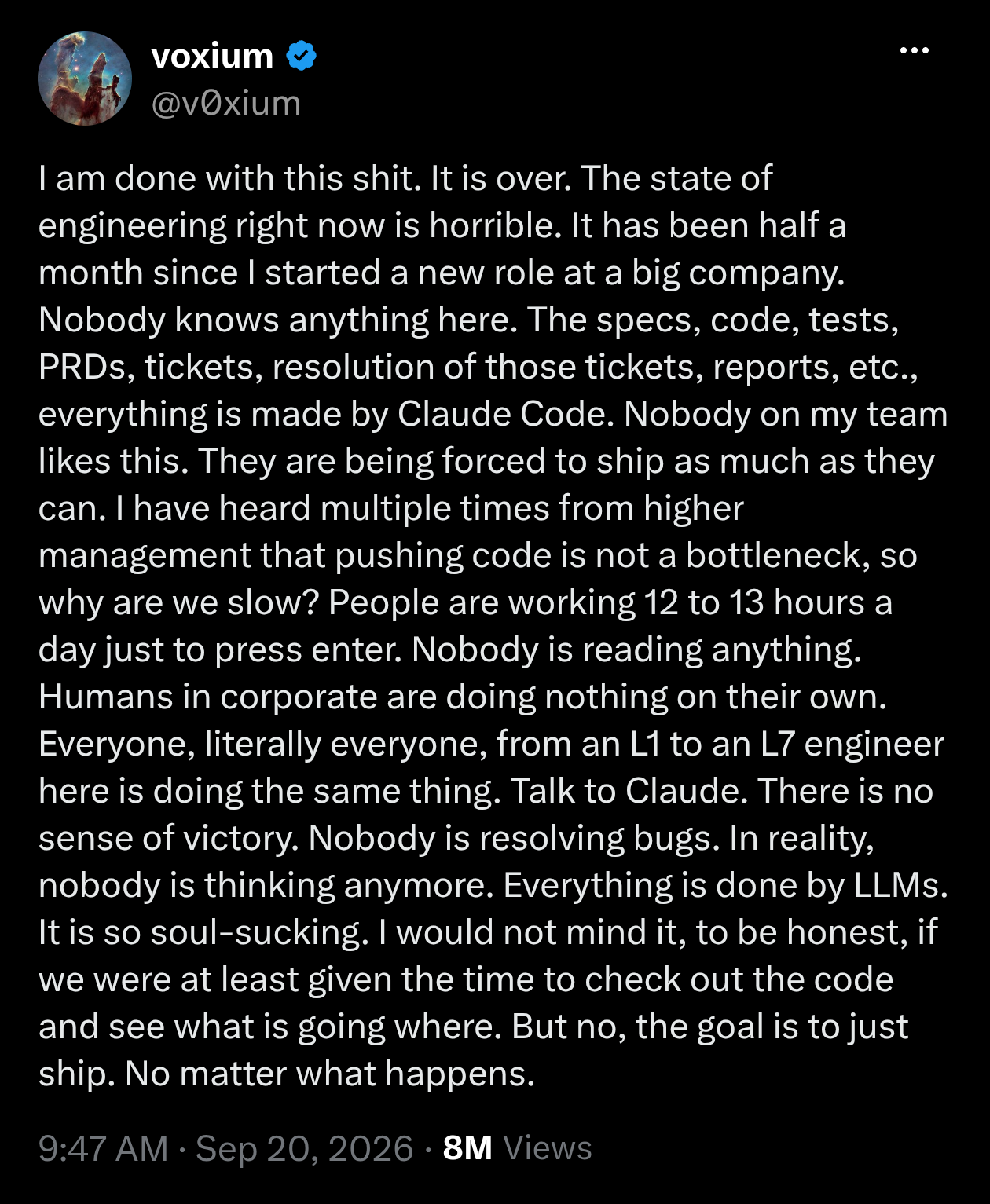
The so-called AI revolution is everywhere now, but for me it’s personal: enterprise software is suffering the repercussions. I’ve worked on internal tools since the start of my career. What defines this world is
- Tight, sometimes unreasonable deadlines
- Minimal scale, with most software projects having ten thousand users at best.
- A lot of obfuscation and a lack of clarity around requirements when it comes to complicated functional processes.
But what is important to note is that the downfall of enterprise software has been a long time in the making, with AI coding just being the last missing piece.
To understand how we got here, we need to understand the factors - three things stand out.
- Quality stopped mattering - Having worked in this space for many years, I’ve come to realize that a vast majority of such internal software is below average. Think line-of-business apps, mostly CRUD apps along with workflow engines, data platforms, reporting solutions, etc. They have been written to meet deadlines fast rather than to survive for years in production. The codebase is often completely illogical in its nature—the kind of stuff you look at and wonder what the person was thinking when they wrote it. But the real shift was that defects started being just numbers on a JIRA board: whether a release was greenlit for production with ten defects or a hundred or five hundred stopped making a difference.
- Enterprise software runs 1-2 years behind the tech industry when it comes to trends. It’s only now that I see trends like Tokenmaxxing and vibe coding taking root in my organization. Over the past few years, there is an arms race that is building up a vibe machine where you input documents and a prompt, and you get a usable application on the other side. But no one is asking the question of whether spinning up new MVPs is the real problem or not. A vast majority of projects in the enterprise space are working on large legacy codebases or application stack modernization initiatives.
- Leadership hates engineers - Most people don’t realize this, but executives hate engineers. Good engineers take an insane amount of money out of budgets, are highly opinionated to the point of being insufferable, and question every requirement and decision. If given a magic solution that could do 80% of what an engineer does (or at least appear to do so) without all the baggage, then they would replace all engineers in a heartbeat.
Put those three together, and the current enthusiasm starts to make sense. The concept of vibe coding for one-shot application development, is basically a wet dream for these executives. I have heard executives espouse vibe coding and literally say stuff like the language or framework the AI uses does not matter. The architecture the agent comes up with does not matter. We should apparently treat the codebase generated by AI as a black box now, with no need to understand it. If there are issues then we should simply ask the agent to fix it.
I 100% DISAGREE WITH THIS.